creative commons license - a great thing to mention in class
Barbara Reisner / James Madison University
Thu, 09/06/2012 - 16:08
Just a comment... I really like having the CC licenses from LOs on the assignments I hand out in class. It's a great way to interject the importance of citing other people's work and it's yet another example of the collaborative nature of science. Having these on assignments to my seniors lets me reinforce some of the things we discussed on Lit&Sem. It's great that everyone is getting credit for their work, but it's also great that we can provide such a good example for our students.
Forums
Case Studies (Chem. Eng. News)
Colleagues,
Chemical and Eng. News has some new Research Case Studies that perhaps would be useful for teaching intro level courses. See the link below.
http://pubs.acs.org/page/cenear/case-studies.html
Sibrina
Forums
Syllabus and Content
Greetings Colleagues,
Although I am on research leave for one semester at OSU, I still need to think about my classes for the Spring 2013 semester. Surprisingly, I was motivated to work on some ideas tonight. Previously, I have used the textbook "Descriptive Inorganic, Coordination, and Solid-State Chemistry," by Rodgers. I love that book, but I found myself supplementing lots of other important topics (symmetry, point groups, MO theory). So now I plan to use Miessler and Tarr. I am thinking about content and the order I want to discuss them during the semester.
Forums
anomalous configurations such as Cr and Cu
I want to think about the question of the so-called anomalous configurations that occur is some d and f-block atoms (shown in yellow in the diagram below).
Forums
"Soft Skills" for first year science students?
Lori Watson / Earlham College
Wed, 07/04/2012 - 10:10
A group of us at Earlham College will be teaching a seminar (1 credit, both semesters) for an interdisciplinary group of first year science students involved in a science themed Living Learning Community. Our general goal for the first semester is to help them develop the interpersonal, collaborative and technology skills necessary for success in science. We've joked that the course should be titled "Playing Well in the Sandbox with New Toys." For example, we might introduce them to googledocs, google+, and the infamous doodle poll. We might encourage teamwork and teach GIS, GPS, and Go
Forums
Rhenium Chemistry
Colleagues,
I hope all is well. I am thinking about bring some rhenium chemistry into the inorganic lab. I could have the students prepare [ReO2(py)4]Cl and characterize it using IR,NMR, UV-vis. What are your thoughts on this idea? This complex is really easy to make starting with [ReOCl3(PPh3)2] and excess pyridine. You let it reflux in acetone/H2O for 90 minutes. I thought about this because [ReO2(py)4]Cl is actually a starting material for my research efforts.
Sibrina
Forums
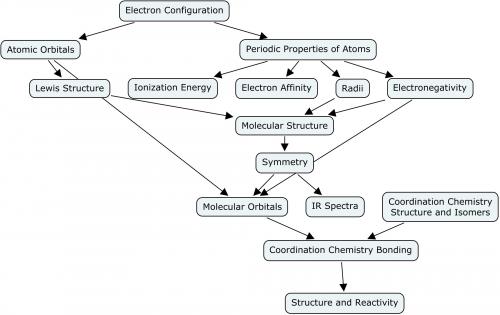
Concept Maps
Clifford Rossiter / SUNY Potsdam
Fri, 05/04/2012 - 10:33
Dear Fellow Vipers,
As the semester is comming to an end, I am trying to make connections between various chapters in Inorganic Chemistry by Miessler and Tarr. I have arrived at the following concept map and would like your input for further refinement.
Sincerely,
Cliff
Forums
Jahn-Teller Demo?
Hi All-
This will certainly sound weird, but does anyone have any ideas for a visual demonstration of the Jahn-Teller Effect? Full disclosure- there will be a film crew visiting us here at Geo Washington where they are doing a documentary on Teller. Fun fact: Jahn-Teller effect got published while Teller was at GW! I was thus hoping to be able to do a demo of sorts to highlight this. If all else fails, I'll set up a Geiger counter and make the needle move....
Thanks
Chris
Forums